Bitcoin SEO Lab · informational
Bitcoin node explained: what does a full node check?
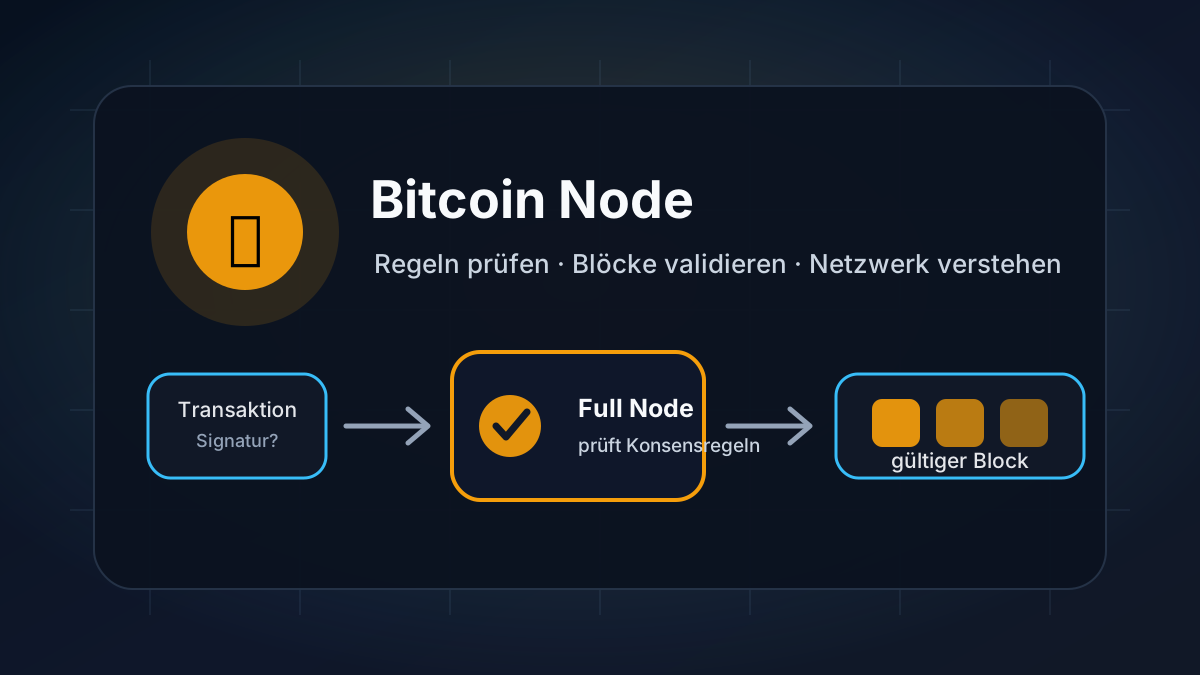
A Bitcoin node is software that participates in the Bitcoin network and checks the protocol rules for itself. It does not blindly trust what miners, exchanges, wallet providers or other participants claim. Instead, it verifies blocks and transactions against the known Bitcoin rules.
For beginners, a node can sound like something only experts need. The idea behind it is central to Bitcoin: many independent participants check the same rules. That means there is no single central referee. For the broader network context, start with What is Bitcoin?.
The short answer
A Bitcoin node:
- downloads blocks and transactions from the network,
- checks whether they follow the consensus rules,
- rejects invalid data,
- can relay valid information to other nodes,
- can help wallets verify transactions more independently,
- but does not automatically create new bitcoin.
Important: a node is not the same as mining. A full node checks rules. Miners collect transactions into blocks and secure those blocks with proof of work. The roles can be combined, but they do not have to be.
Why are nodes important for Bitcoin?
Bitcoin does not work only because miners find blocks. It also works because nodes check those blocks. If a miner builds a block that breaks the rules, nodes can reject it. Computing power alone is not enough; the result must also be accepted by network participants.
Nodes strengthen Bitcoin in three ways:
- Rule checking: they verify transactions, blocks, signatures and spent outputs.
- Independence: users can check for themselves instead of trusting a remote server.
- Network distribution: nodes relay valid data and make the network more resilient.
This does not mean every person must run a node immediately. But anyone who wants to understand Bitcoin should know what nodes do.
What does a Bitcoin node actually check?
For beginners, the main categories are enough:
| Area | What the node checks | Why it matters |
|---|---|---|
| Transactions | Are signatures valid and are coins not already spent? | Protection against invalid payments and double spending |
| Blocks | Does the block follow consensus rules? | Invalid blocks are not accepted |
| Supply | Are no extra bitcoin created beyond the rules? | Protection of the monetary rules |
| History | Does a new block fit the existing blockchain? | Shared transaction history stays consistent |
| Network policy | Are data acceptable to relay? | Helps reduce spam and malformed data |
These checks happen automatically inside node software. The user does not inspect every transaction manually.
Full node, light wallet and explorer: what is the difference?
Many beginners use a wallet app without running a node. That can be enough for early learning, but it often means the wallet asks remote servers which transactions and balances belong to your addresses. That is convenient, but less independent and can reduce privacy.
| Tool | What happens? | Benefit | Trade-off |
|---|---|---|---|
| Full node | Checks blockchain rules locally | high independence, more control | needs storage, bandwidth and maintenance |
| Light wallet | Asks servers or simplified data sources | easy and fast | more trust in third parties |
| Block explorer | Website shows blockchain data | useful for learning and lookup | not a substitute for your own verification |
A wallet is still important: it manages keys and signs transactions. If key management is still unclear, read Bitcoin wallet explained.
What does a node have to do with the mempool?
Each node can keep its own mempool. It contains valid transactions known to that node but not yet confirmed in a block. So “the mempool” is not one central queue; it is a simplified name for many local mempools.
When a new transaction appears, a node checks whether it appears valid and whether it can be relayed under local policy. Only then does it enter that node's mempool. The article What is the mempool? explains this waiting area in more detail.
Confirmations: what role does the node play?
When miners find a new valid block, nodes check that block. If it includes your transaction and the node accepts the block, the transaction is confirmed from that node's perspective. Each further block adds another confirmation.
That helps explain why a Bitcoin payment is not simply “approved by a bank”. The payment is checked under network rules, included in a block, and then becomes harder to change as more blocks follow. Fees influence how attractive a transaction is for miners. For the block-space side, read Bitcoin transaction fees explained.
Do you need to run your own node?
No. For early learning, running a node is not mandatory. Many people start with small test amounts, a reputable wallet and basic security education. A personal node becomes more interesting if you want to:
- verify more independently,
- connect your wallet to your own server,
- improve privacy against third-party wallet servers,
- understand Bitcoin more technically,
- use on-chain transactions regularly over the long term.
A sensible next step is usually: understand wallet and seed-phrase basics first, then experiment with documentation, testnet or a pruned node, and only later connect real wallet activity if you understand the setup.
What does a full node require?
Exact requirements change with software versions, blockchain size and usage. In general, a full node needs:
- enough storage for blockchain data or a pruned mode,
- a stable internet connection,
- regular node software updates,
- a device that can run reliably for long periods,
- basic understanding of backups and system maintenance.
Check the current requirements in Bitcoin Core or in the documentation of the node distribution you choose. A pruned node does not permanently keep the full old blockchain, but it still verifies the rules while syncing. For some wallet integrations, archive use cases or advanced setups, an unpruned full node can be more suitable.
Common misunderstandings
“A node earns bitcoin”
A normal node does not earn new bitcoin. New bitcoin are created through mining as part of the block reward. A node can verify and relay blocks, but it does not replace mining hardware.
“More nodes automatically make transactions faster”
More nodes can make the network more resilient, but they do not directly increase block space. Confirmation time mainly depends on mining, block intervals, mempool conditions and fee rate.
“A node protects against every mistake”
A node checks network rules, but it does not automatically protect against phishing, wrong addresses, unsafe seed storage or scams. Security basics still matter.
“An explorer is like your own node”
An explorer can be useful, but it shows the view of a third-party service. Your own node enables your own verification. For many everyday learning situations, an explorer is fine, but it is not the same trust model.
Beginner-friendly learning path
If you want to approach the topic step by step:
- Understand what Bitcoin as a network is meant to do.
- Learn that wallets manage keys, not “coins” inside the app.
- Read why transactions can wait in the mempool.
- Observe with small examples how confirmations appear.
- Only then study node software and operation.
This avoids mixing technical responsibility with real financial responsibility too early.
Frequently asked questions
Is running a Bitcoin node legal?
That depends on your country and local rules. In many places, running a node is generally allowed. Regulation, taxes, internet terms or company policies can still matter in specific situations. This article is not legal advice.
Can I run a node on an old laptop?
It can be possible if storage, internet connection and operating system are suitable. For reliable long-term operation, consider power use, updates, disk health and network security.
Do I need a node for a hardware wallet?
Not necessarily. Many hardware-wallet setups work with the manufacturer's software or third-party wallets. If you want more independent verification and better privacy, you can connect a compatible wallet to your own node.
Does my node see my private keys?
A plain Bitcoin node does not need private keys to verify blocks and transactions. Private keys belong in the wallet. If wallet and node software are combined or connected, understand the exact architecture before using meaningful amounts.
Conclusion
A Bitcoin node is an independent rule checker in the network. It does not automatically produce new bitcoin and it is not a guarantee against user mistakes, but it makes Bitcoin's core idea visible: rules are not enforced by one central authority, but checked by many participants themselves. For beginners, a node is first a learning concept. Later, it can become a practical tool for more independence, privacy and technical understanding.