Bitcoin SEO Lab · informational
What is proof of work? Bitcoin's security model explained
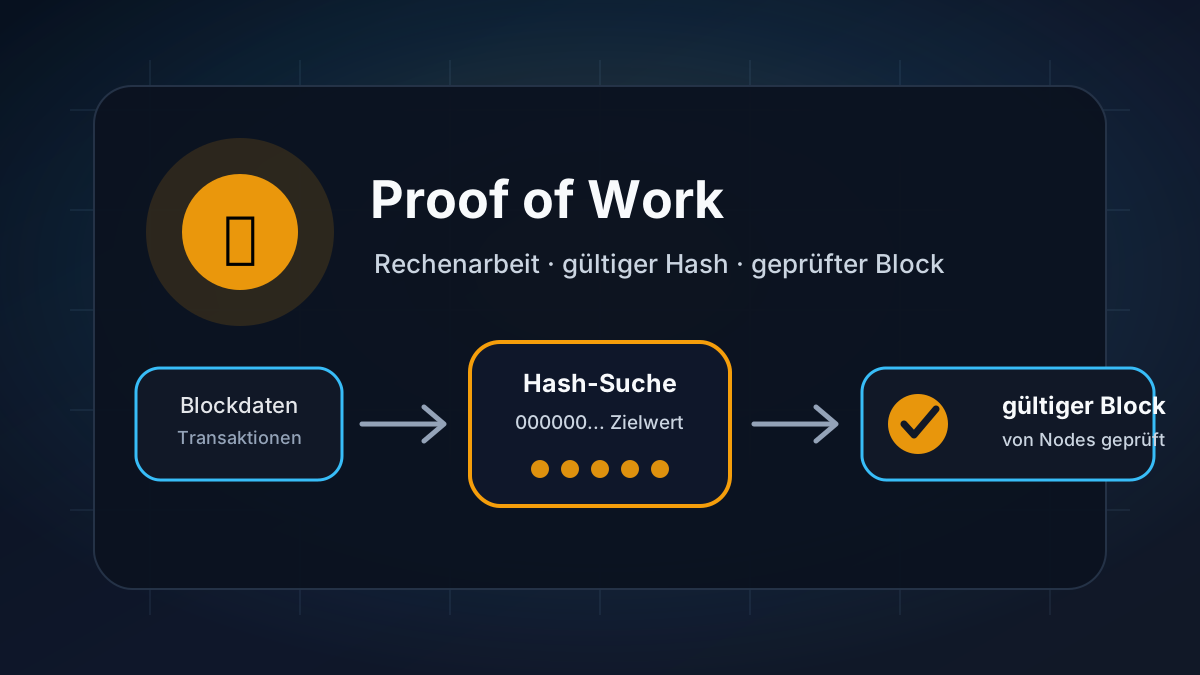
Proof of work means that anyone who wants to add a new block to Bitcoin's blockchain must show that real computation was performed. Miners search for a valid block hash that fits the current network difficulty. Finding such a hash is intentionally costly, but checking it is easy for Bitcoin nodes.
For beginners, proof of work matters because it explains why old Bitcoin blocks are hard to rewrite and why mining is not simply “creating coins”. For the broader network context, start with What is Bitcoin?. If you want to understand who checks blocks and transactions independently, read Bitcoin node explained.
The short answer
Proof of work is a process where miners:
- collect valid transactions into a block,
- perform many hash attempts,
- look for a block hash below the current target,
- spend electricity, hardware and time,
- and are rewarded only if nodes accept their block as valid.
In one sentence: proof of work makes Bitcoin's block history expensive to change and easy for nodes to verify.
Important: proof of work is not a trust badge for a person or company. It is technical evidence that a specific block required real computational work.
Why does Bitcoin need proof of work?
Bitcoin has no central operator deciding which transactions are final. The network therefore needs a way to agree on one shared order of blocks. Proof of work makes alternative histories expensive to build and valid work easy to check.
It helps with several problems at once:
| Problem | Role of proof of work | Why it matters |
|---|---|---|
| Transaction order | Blocks are linked one after another with computation | prevents simple competing wish-histories |
| Cost of manipulation | An old history would need to be rebuilt with new work | makes later changes increasingly expensive |
| Open participation | Anyone can mine if they follow the rules | no central permission gate is required |
| Block-level spam resistance | Blocks require scarce resources | attacks cost real energy and hardware |
Proof of work alone is not enough. Nodes also check whether a block is valid. A miner cannot use “more work” to create invalid bitcoin.
What do miners actually calculate?
Miners change certain data inside the block and calculate hashes again and again. A hash is like a digital fingerprint: even a tiny input change produces a completely different result. The miner is looking for a hash below a target value. The lower the target, the harder the search.
A simple analogy is a combination lock. There is no elegant shortcut to know the correct combination immediately. Miners try many variations. Once one works, everyone else can check the result quickly.
The work is not meant to solve an outside scientific problem. Its usefulness is inside Bitcoin itself: it makes block proposals scarce, verifiable and costly to replace.
What is the difficulty?
Difficulty describes how hard it currently is to find a valid block. Bitcoin regularly adjusts this difficulty so blocks are found roughly every ten minutes on average. If more total mining power joins, difficulty rises. If mining power drops, difficulty can fall.
This adjustment matters because otherwise blocks would become much too fast when more hardware joins or much too slow when hardware leaves. Individual block times still vary. Ten minutes is a long-term average, not a promise for every block.
Is proof of work the same as mining?
Mining is the practical process where proof of work is performed. Miners collect transactions, choose candidates from the mempool, and build a block. They usually prefer transactions with attractive fee rates because fees are part of their income.
When a miner finds a valid block, it contains a special coinbase transaction. Through it, the miner receives the block subsidy and the transaction fees in that block. The block subsidy falls roughly every four years through the halving, so fees become more important for long-term mining incentives. For the fee side, see Bitcoin transaction fees explained.
Why do nodes check miners' work?
Proof of work only shows that work was performed. It does not automatically prove that every rule was followed. Bitcoin nodes therefore check each block against the consensus rules. For example, they verify:
- whether the proof-of-work hash meets the target,
- whether the included transactions are valid,
- whether coins are not spent twice,
- whether the block reward is not too high,
- whether the block fits the existing blockchain.
If a miner publishes an invalid block, nodes can reject it. This is central: miners propose blocks, but nodes decide for themselves whether to accept them. More on this rule-checking role is in Bitcoin node explained.
Why do more confirmations increase security?
One confirmation means a transaction is included in a valid block. Each additional confirmation is another block built after it. Anyone who wanted to change an older transaction would need to replace not only the original block, but also catch up with and overtake the later work.
That is why practical security increases with more confirmations. Small low-risk payments and very large payments can reasonably use different waiting policies. Bitcoin does not define one magic number for every situation; wallets, exchanges and recipients choose confirmation policies based on risk.
Why does proof of work use energy?
The energy question is valid and should not be dismissed. Proof of work uses real energy because those external costs make attacks on the block history harder. Whether that cost is justified is a broader judgment about Bitcoin's usefulness: censorship-resistant settlement, open participation, independent verification and a global rule set without one central operator.
For a neutral explanation, keep three points separate:
- Energy use is part of the security model, not an accidental side effect.
- The energy source matters, because emissions and grid impact depend strongly on location and generation mix.
- Mining is economically driven, so miners search for cheap energy; the effects can be positive or negative depending on the situation.
This article does not claim Bitcoin is socially good or bad. It explains why proof of work is designed this way and what trade-offs come with it.
Can a miner create invalid bitcoin with enough work?
No. A miner can spend enormous computation and still produce a block that nodes reject. If the block creates more bitcoin than allowed, spends coins incorrectly, or breaks another consensus rule, the work does not make it valid. Energy cannot replace rule verification.
This is why mining and node validation are different roles. Miners compete to propose blocks. Nodes check whether those blocks follow the Bitcoin rules.
Proof of work vs proof of stake in brief
Proof of stake is a different security model where staked capital inside the protocol plays a central role instead of external computation. Many modern networks use variants of it. Bitcoin continues to use proof of work because it is closely tied to Bitcoin's assumptions about open participation, outside costs and simple independent verification.
For beginners, the main point is: proof of work and proof of stake are not interchangeable detail words. They shape how a network makes attacks expensive, coordinates participants and distributes power.
Common misunderstandings
“Miners alone decide Bitcoin's rules”
Miners matter because they produce blocks. But they cannot force invalid rules on nodes that reject them. The interaction between miners, nodes, wallets, users and markets matters more than any one group alone.
“More energy automatically means better rules”
More hash power can make attacks on block history harder. It does not make an invalid block valid. Rules are checked by node software; energy does not replace validation.
“Proof of work creates unlimited bitcoin”
New bitcoin are created only according to fixed rules as a block subsidy, and that subsidy decreases over time. A block creating more bitcoin than allowed would be invalid and rejected by nodes.
“One miner can permanently censor transactions”
A miner can choose which transactions to include in its own block. Permanent censorship is harder because other miners can also find blocks. Still, mining centralization and pool structure are real topics to watch.
Who benefits from understanding this?
You do not need to calculate proof of work yourself to use Bitcoin. But the concept is useful when you want to understand:
- why confirmations matter,
- why mining and nodes have different roles,
- how fees, mempool and block space connect,
- why energy and security are discussed together,
- why marketing claims should be separated from actual network rules.
Safety and trust note
This article is not investment advice, a recommendation to buy, or a statement about future prices. Proof of work is a technical security mechanism. Whether Bitcoin is useful for a person, company or purpose depends on many factors and should be evaluated separately from price claims.
Further reading
- The Bitcoin white paper by Satoshi Nakamoto
- Bitcoin Core documentation and developer references
- Hash, block, difficulty, nonce, coinbase transaction and confirmation as core terms
- What is the mempool? for transactions waiting before block inclusion
- Bitcoin node explained for independent block verification
Conclusion
Proof of work is the process that makes Bitcoin block proposals costly and keeps verification simple. Miners perform computation, nodes check the rules, and additional confirmations make later changes increasingly expensive. To understand Bitcoin, do not treat proof of work as only a mining buzzword; treat it as the interaction between energy, incentives, consensus rules and independent validation.