Bitcoin SEO Lab · informational
Bitcoin confirmations explained: when is a transaction settled?
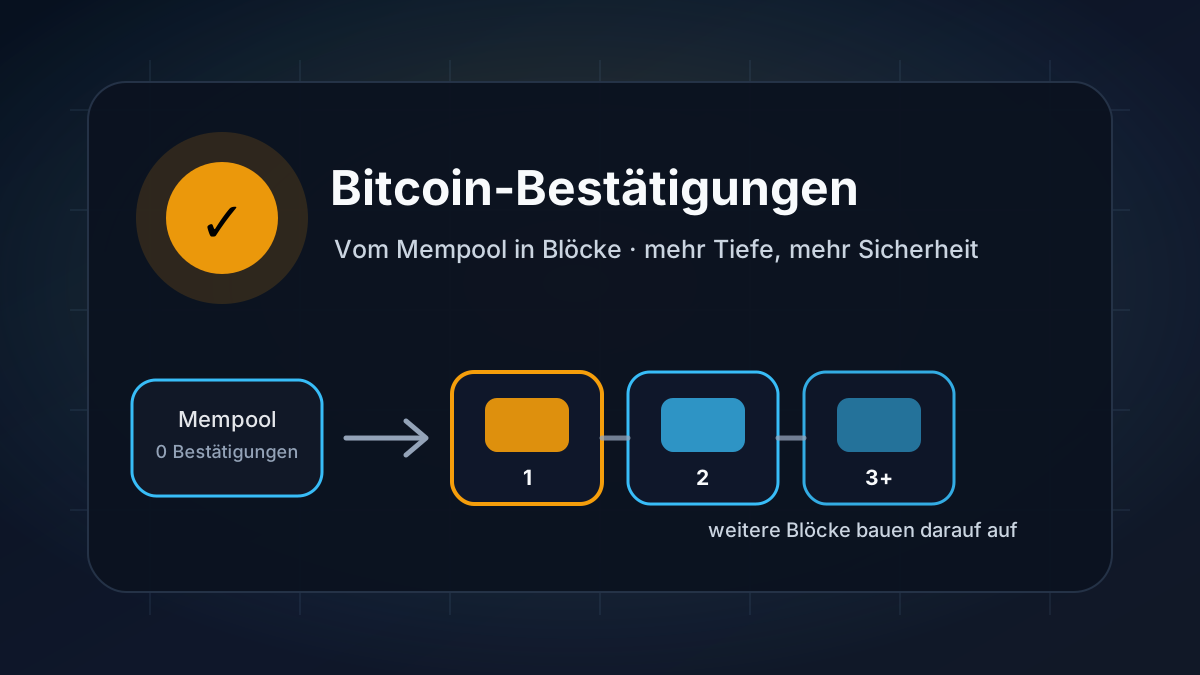
A Bitcoin confirmation means that a transaction has been included in a valid block. Before that, it may already be visible on the network, but it is not yet part of the blockchain. Each additional block built after it adds another confirmation.
For beginners, confirmations matter because Bitcoin payments are not approved by one central operator. A transaction is checked by nodes, waits in the mempool, and is then included in a block by miners. For the broader context, start with What is Bitcoin?.
The short answer
Bitcoin confirmations show how deeply a transaction sits in the blockchain:
- 0 confirmations: the transaction is still unconfirmed and waiting for a block.
- 1 confirmation: it has been included in a valid block.
- More confirmations: later blocks build on top of that block, making changes increasingly unlikely.
In one sentence: a confirmation is not a bank approval stamp; it is a technical signal that nodes have accepted a block containing your transaction.
What happens before the first confirmation?
When you send bitcoin, your wallet creates a transaction and signs it with the relevant keys. The transaction is then relayed to the network. Nodes check rules such as valid signatures and whether the same coins have already been spent.
If a node accepts the transaction, it may place it in its mempool. The mempool is the waiting area for valid but unconfirmed transactions. For more detail, read What is the mempool?.
How does the first confirmation happen?
Miners select transactions from the mempool and build a candidate block. When a miner finds valid proof of work for that block, the block is propagated through the network. Nodes then verify it themselves.
If the block is valid and contains your transaction, the transaction has one confirmation from those nodes' perspective. To understand why finding a block is computationally costly but checking it is comparatively easy, read What is proof of work?.
Why do more confirmations increase confidence?
After the first confirmation, later blocks can build on the same chain. That makes it increasingly difficult to change history from that point. An attacker would have to replace not only the block containing your transaction, but also catch up with the blocks built after it.
For everyday understanding, the idea is simple: the more valid blocks follow your transaction, the more deeply it is embedded in the shared history. That does not mean every payment needs the same number of confirmations. The right level depends on risk.
How many confirmations do you need?
There is no universal number that fits every situation. Wallets, exchanges and merchants use their own rules. As a learning guide:
| Situation | Typical interpretation | Why |
|---|---|---|
| Small test payment | watching or 1 confirmation may be enough | low-risk learning case |
| Normal on-chain payment | several confirmations can be sensible | lower risk from reorgs or mistakes |
| Exchange deposit | the exchange policy matters | service providers set their own thresholds |
| Large amount or irreversible handover | be more conservative | higher cost if a payment is misread |
This table is not financial or legal advice. It only explains why “how many confirmations?” depends on context.
What does “0 confirmations” mean?
0 confirmations means the transaction is not yet in a block. It may appear in wallets or explorers, but it is still unconfirmed. Depending on wallet support, it may still be replaced, for example with Replace-by-Fee.
That does not automatically mean something is wrong. During busy periods, a transaction can simply wait. The relevant factors are mempool conditions, fee rate, wallet settings and whether nodes accepted the transaction.
What role do fees play?
Bitcoin blocks have limited space. When many transactions are waiting, miners usually pick transactions with attractive fee rates first. A fee rate that is too low can therefore mean a longer wait.
The fee is not directly based on the euro value of the payment. What matters is the technical size of the transaction and the fee rate, often measured in sat/vB. For more context, read Bitcoin transaction fees explained.
What role does your own node play?
A Bitcoin node can verify blocks and transactions for itself. That means you rely less on remote wallet servers or block explorers. Beginners do not need to run a node immediately, but it helps explain what “confirmed” means under Bitcoin rules.
In short: an explorer shows you a view of the network. A node checks the rules itself. The difference is explained in Bitcoin node explained.
Common misunderstandings
“A visible transaction is final”
Not necessarily. Visible only means a service or node knows about the transaction. Inclusion in a valid block creates the first confirmation.
“One confirmation always takes exactly ten minutes”
No. Ten minutes is the long-term target average block interval. Individual blocks can be found faster or slower.
“A high fee guarantees immediate confirmation”
A higher fee rate can improve the chance of fast inclusion, but it cannot guarantee an exact time. Mining, mempool conditions and block discovery remain variable.
“More confirmations make my wallet safer”
Confirmations relate to the transaction in the blockchain. They do not replace safe handling of seed phrases and private keys. If key safety is still unclear, read Seed phrase storage.
Beginner checklist
- Check whether your wallet shows the transaction as sent.
- Separate “unconfirmed” from “confirmed.”
- Avoid rushed repeated fixes if you do not understand RBF, CPFP or wallet details.
- For important amounts, use multiple information sources and wait more conservatively.
- Test new wallets or workflows with small amounts first.
- Never enter your seed phrase just because a transaction is waiting.
Frequently asked questions
Why is my Bitcoin confirmation taking so long?
Common reasons include high demand for block space or a low fee rate. Wallet settings, exchange processing and local mempool differences can also affect what you see.
Can an unconfirmed transaction disappear?
Yes. It can be removed from some mempools or replaced by another valid transaction. That does not automatically mean coins are lost. The practical next step depends on your wallet, RBF status and situation.
Are six confirmations always necessary?
Not always. Some services require six or more confirmations, while others require fewer. The higher the amount or the more irreversible the handover, the more conservative you should be.
Can a miner confirm an invalid transaction?
A miner can try to include invalid data in a block. Bitcoin nodes would reject an invalid block. That is why independent nodes matter for rule verification.
Safety and trust note
This article is a technical explanation, not investment advice, wallet advice or a procedure for handling large amounts. Network conditions, wallet features and service policies change. Check important transactions carefully, start with small test amounts, and never share your seed phrase or private keys.